Painting your house exterior is one of the most impactful ways to boost its curb appeal, protect it from the elements, and make it feel new again. But as you start planning this major project, one of the first and most critical questions you’ll face is, “How much paint do I need?” Getting this number right is the key to a smooth, efficient, and budget-friendly project. Guessing can lead to multiple trips to the store, wasted money on unused gallons, or even a mismatched final coat.
This guide is designed to take the guesswork out of the equation. We’ll walk you through a step-by-step process to accurately calculate the amount of paint needed for your house exterior. You’ll learn how to measure your home, understand the factors that influence paint consumption, and get specific tips for choosing the right paint to withstand the demanding Texas climate. With this information, you can approach your painting project with confidence and a clear plan.
You will learn how to measure your home’s surface area, what factors can make you need more or less paint, and how to select a durable product that will last.
Table of Contents
Why Accurate Paint Estimation Matters
Before we dive into the calculations, it’s important to understand why taking the time to estimate your paint needs is so beneficial. It might seem like a tedious extra step, but a few minutes of measuring can save you significant headaches down the road.
- Avoids Wasting Money: Exterior paint can be expensive, and buying several extra gallons “just in case” can add hundreds of dollars to your budget. That unused paint often ends up sitting in a garage for years, eventually becoming unusable. An accurate estimate ensures you buy only what you need.
- Prevents Project Delays: There’s nothing more frustrating than running out of paint midway through a project, especially when you’ve rented equipment or set aside a specific weekend to get the job done. An unexpected trip to the paint store can bring your progress to a screeching halt.
- Ensures Color Consistency: If you run out of a custom-tinted color, getting an exact match in a new batch can be tricky. Even slight variations between paint cans can be noticeable on a large surface like an exterior wall. Buying all your paint in one go guarantees a perfectly uniform color across your entire house.
Step-by-Step Guide to Calculating Surface Area
The foundation of any good paint estimate is knowing the total square footage of the surfaces you need to cover. Grab a tape measure, a notepad, and a calculator, and follow these simple steps.
Step 1: Measure the House Perimeter
Start by measuring the length of all the exterior walls of your house and adding them together. This will give you the total perimeter. For a simple rectangular house, you can measure two adjacent sides, add them together, and multiply by two.
Example: A rectangular house is 50 feet long and 40 feet wide. The perimeter is (50 + 40) x 2 = 180 feet.
Step 2: Measure the Wall Height
Next, measure the height of your walls from the top of the foundation to the roofline. If your house is on a slope, take measurements at a few different points and use the average height for your calculation. Don’t include the height of any triangular gables in this step; we’ll calculate those separately.
Example: The wall height is 10 feet.
Step 3: Calculate the Total Wall Area
Now, multiply the perimeter of your house by its height. This will give you the total square footage of your exterior walls.
Example: 180 feet (perimeter) x 10 feet (height) = 1,800 square feet.
Step 4: Account for Gables
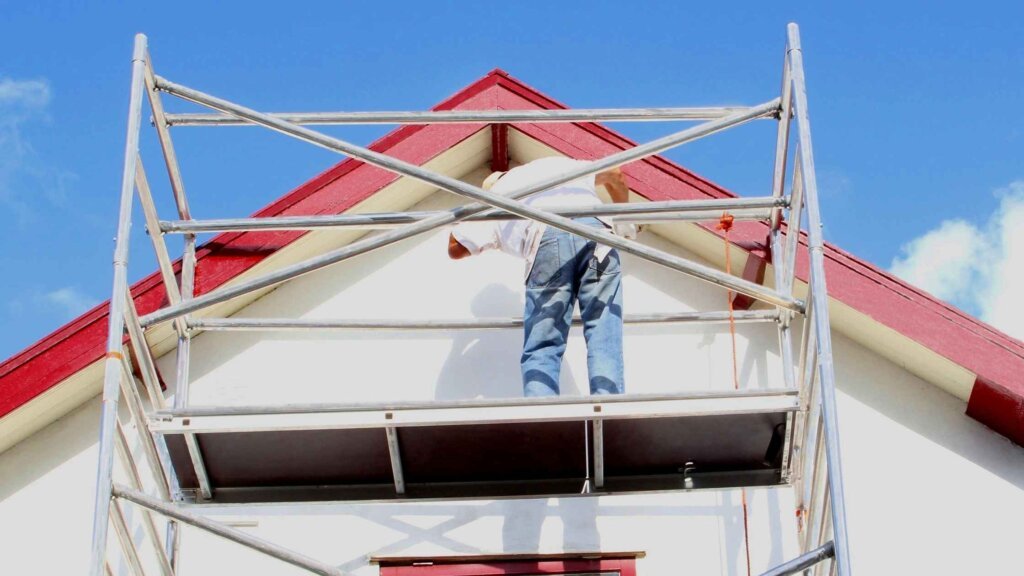
Gables are the triangular sections of wall under a sloped roof. To calculate their area, measure the width of the gable at its base and its height from the base to the peak. Then, use the formula for a triangle: (Width x Height) / 2. Do this for each gable and add the totals together.
Example: A gable is 40 feet wide and 8 feet tall. The area is (40 x 8) / 2 = 160 square feet.
Step 5: Subtract Doors and Windows
You don’t need to be exact here, but subtracting the areas you won’t be painting will give you a more accurate final number. As a general rule, you can use these standard averages:
- Average door: 20 square feet
- Average window: 15 square feet
Count the number of doors and windows on your home’s exterior and subtract their total area from your wall calculation.
Example: The house has 2 doors and 15 windows. The area to subtract is (2 x 20) + (15 x 15) = 40 + 225 = 265 square feet.
Final Calculation
Add your wall area and gable area, then subtract the area for doors and windows.
Example: (1,800 sq ft walls + 160 sq ft gable) – 265 sq ft doors/windows = 1,695 square feet of paintable surface.
For a quick and easy way to check your math, you can use an online tool like the Behr paint calculator.
What to Consider When Estimating Paint Needs
Your home’s total square footage is the starting point, but several other factors can significantly impact how much paint you’ll actually use.
- Surface Texture: The texture of your exterior walls is one of the biggest variables. Porous and rough surfaces require much more paint than smooth ones because the paint needs to fill in all the nooks and crannies.
- Smooth siding (wood, vinyl, fiber cement): Follows standard coverage guidelines.
- Stucco, brick, or rough-sawn wood: Can increase paint consumption by up to 50%.
- Porosity of the Surface: Has the surface been painted before? A previously unpainted or poorly sealed surface will act like a sponge, soaking up the first coat of paint. In these cases, using a dedicated primer first is essential. A primer seals the surface, so your more expensive topcoat will go on more smoothly and require less product.
- Color Change: If you are making a dramatic color change—like going from a very dark color to a light one, or vice versa—you will almost certainly need more than one coat. A tinted primer can be a lifesaver here. Ask the paint store to tint your primer to a shade similar to your topcoat to improve coverage.
- Application Method: How you apply the paint also matters.
- Brushes and rollers: Offer the most control and the least waste.
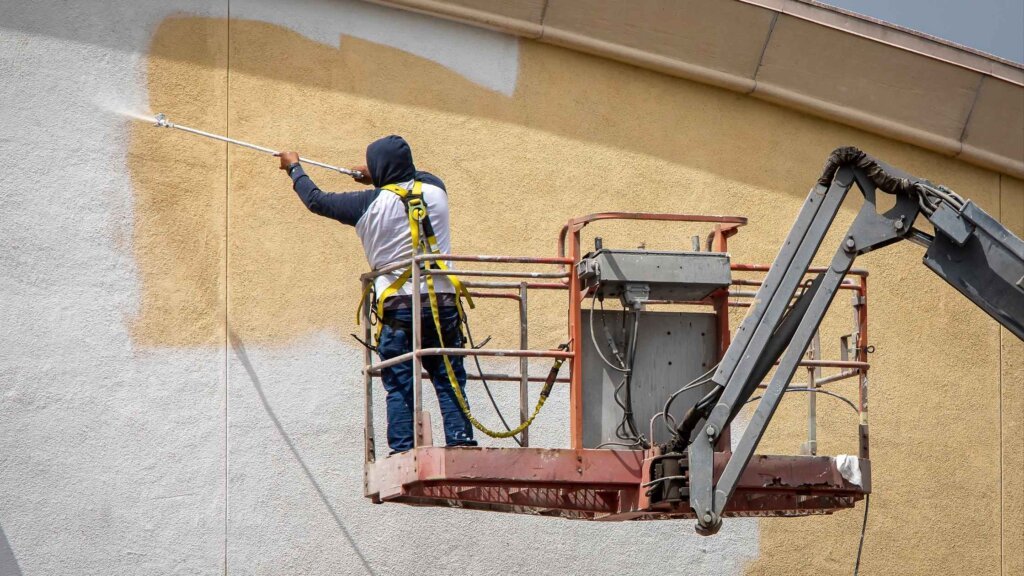
- Paint sprayers: Are much faster for large areas but can use up to 30% more paint due to overspray.
For more guidance on how these factors affect your project, you can consult helpful resources like the Lowe’s paint calculator and its accompanying articles.
General Guidelines for Paint Coverage
So, how much paint do you actually need? Once you have your final square footage, you can use these general guidelines to figure out the number of gallons required.
- Paint Coverage Per Gallon: Most manufacturers state that one gallon of exterior paint will cover between 250 and 400 square feet. The exact number will be listed on the paint can. It’s always a good idea to be conservative and use 300 square feet per gallon in your estimate to be safe.
- The Two-Coat Rule: For exterior painting, always plan for two full coats. A single coat may look fine at first, but a second coat provides better color richness, durability, and protection against the elements. This is not a corner you want to cut.
- Trim and Gutter Paint: Don’t forget about the trim, shutters, and gutters. A good rule of thumb is to plan for one gallon of trim paint for every six to eight gallons of wall paint. To be more precise, you can measure the length of your trim boards and gutters. One linear foot of a 6-inch-wide trim board is 0.5 square feet.
Example Calculation: For our 1,695 sq ft house, using an estimate of 300 sq ft per gallon:
- 1,695 / 300 = 5.65 gallons per coat.
- For two coats, you would need 5.65 x 2 = 11.3 gallons.
- In this case, you should buy 12 gallons of wall paint.
- For the trim, you would need about 2 gallons.
Choosing the Right Paint for the Texas Climate
For homeowners in Dallas and across Texas, choosing a paint isn’t just about color—it’s about survival. The intense sun, high humidity, and dramatic temperature swings demand a high-performance paint that can stand up to the challenge.
- UV Resistance: The relentless Texas sun can cause low-quality paints to fade, chalk, and break down quickly. Look for a 100% acrylic latex paint with excellent UV protection to keep your colors vibrant.
- Moisture and Mildew Resistance: High humidity, especially in East Texas and along the coast, creates the perfect breeding ground for mildew. Choose a paint that contains a mildewcide to prevent unsightly green and black stains from forming on your walls.
- Flexibility and Adhesion: Extreme temperature fluctuations can cause building materials to expand and contract. A high-quality paint will remain flexible, adhering to the surface without cracking or peeling.
Recommended Brands:
- Sherwin-Williams Duration Exterior Acrylic Latex: Known for its durability and advanced acrylic co-polymers, it forms a thick, flexible layer.
- Behr Premium Plus Ultra Exterior Paint: A paint-and-primer-in-one that offers excellent coverage and resistance to fading and stains.
Navigating these choices can be tough. For expert advice tailored to your Dallas-area home, consult with the professionals at America’s General Contractor. Their experience with local conditions can help you select the perfect product.
Tips for a Successful Exterior Painting Project
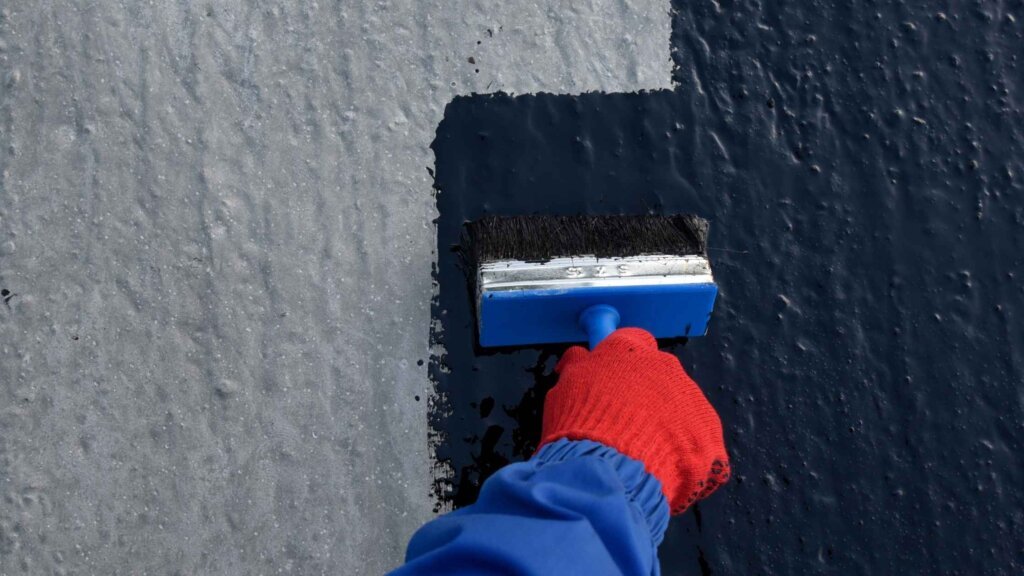
A great paint job is about more than just the paint itself. Follow these tips for a professional-quality result.
- Thorough Surface Prep: This is the most important step. As detailed in resources like HowStuffWorks’ guide to exterior prep, you must clean the walls thoroughly, scrape away any peeling paint, and repair any damaged areas before you even think about opening a can of paint.
- Invest in Quality Tools: Good brushes and rollers hold more paint and apply it more evenly, reducing drips and streaks.
- Watch the Weather: Avoid painting in direct sunlight or on extremely hot days, as the paint can dry too quickly and fail to adhere properly. Don’t paint if rain is in the forecast.
Conclusion
Calculating how much paint you need for your house exterior may seem daunting, but it’s a straightforward process that sets you up for success. By carefully measuring your home, considering the texture and condition of your walls, and always planning for two coats, you can create an accurate estimate that saves you time, money, and stress. For Texas homeowners, selecting a durable, high-quality paint that can withstand the harsh climate is just as important.
With a solid plan in hand, you’re ready to transform your home’s exterior and enjoy the results for years to come.
Ready to start your project but prefer to leave it to the professionals? If you’re in Dallas or the surrounding Texas area and want a flawless finish without the hassle, visit America’s General Contractor to schedule a consultation for expert exterior painting services.