
Table of Contents
Introduction: The Budget Renovation Hack
We have all seen it. You walk into a guest bathroom or a master suite, and everything looks decent—the floor is clean, the walls are a fresh neutral gray—but then your eyes land on the vanity. Maybe it is a dusty rose laminate from 1992, or perhaps it is that yellowing “cultured marble” with the swirl pattern that screams the 1980s.
It is the single feature that dates your entire bathroom.
As experienced general contractors serving the Dallas-Fort Worth area, we hear this complaint constantly. Homeowners are desperate to update their space, but they aren’t always ready to drop thousands of dollars on a full-scale remodel involving demolition and plumbing work. They look at that ugly vanity and ask the ultimate budget question: “Can you paint bathroom countertops?”
The short answer is yes. You absolutely can paint bathroom countertops, and when done correctly, the results can be shockingly realistic. It is one of the most effective, high-impact budget DIY projects you can tackle in a weekend.
But there is a catch.
Painting a countertop isn’t like painting a wall. Walls don’t get soaked with water, scrubbed with abrasive cleaners, or have hot curling irons set on them. If you use the wrong paint or skip the prep work, your new “faux granite” finish will peel, bubble, and flake off within months.
In this comprehensive guide, we are going to put aside the marketing fluff found on the back of paint kits and give you the contractor’s honest perspective. We will cover which materials you can actually paint, the best kits to use, the safety precautions you must take, and the critical preparation steps that separate a 5-year finish from a 5-week failure.
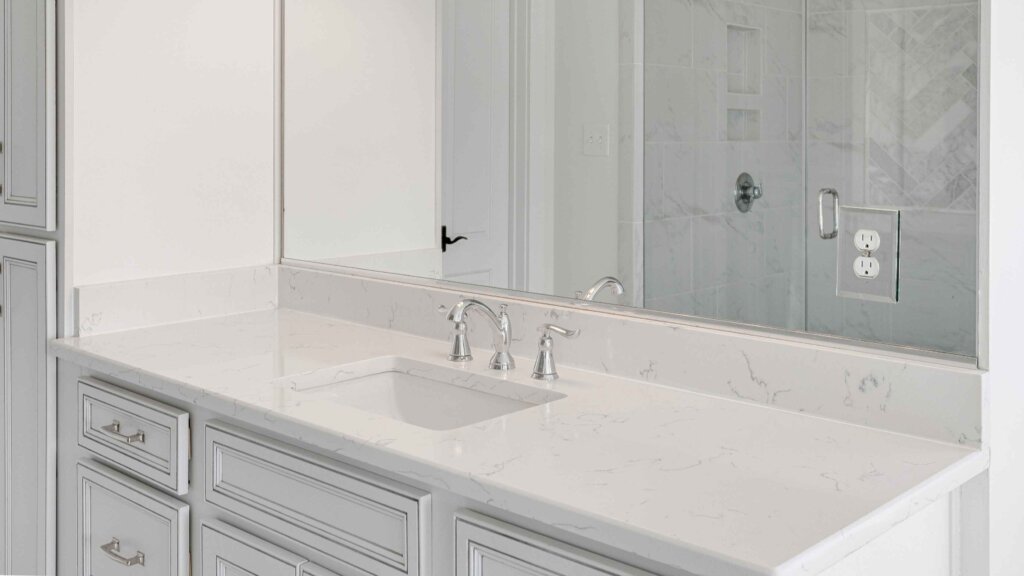
Part 1: The Reality Check – Is Painting Countertops a Good Idea?
Before you head to the hardware store to buy gallons of primer, you need to manage your expectations. Painting your vanity is a “resurfacing” technique. It is essentially a cosmetic layer sitting on top of your old counter. It is not a structural repair.
The Pros (Why You Should Do It)
- The Cost Factor: This is the biggest driver. A high-quality countertop paint kit costs between $50 and $150. Compare that to purchasing a new custom stone slab, which can easily run $1,500+ installed. For budget-conscious homeowners, the savings are undeniable.
- The Speed: You can completely transform the look of your bathroom in a single weekend (usually 2 days of active labor and a few days of cure time). It requires no demolition, meaning no plumbing disconnects (usually) and no debris to haul away.
- Customization: You aren’t limited to what is in stock at the big box store. You can sponge on gray and white for a Carrara marble look, or use black and gold for a dramatic granite effect. You have total creative control over the aesthetic.
The Cons (Why You Might Hesitate)
- Durability Limits: Even the best epoxy paint is essentially hard plastic. It will never be as hard as stone (Quartz or Granite). If you drop a heavy glass perfume bottle on it, it might chip.
- Heat Sensitivity: You cannot place hot tools (straighteners, curling irons) directly on a painted surface. The heat will melt, discolor, or blister the topcoat.
- Lifespan: This is a semi-permanent solution. Expect a well-painted countertop to look good for 2 to 5 years.
The Contractor’s Verdict: Painting is an excellent solution for guest bathrooms, powder rooms, or house flips where budget is king and daily wear-and-tear is low. However, for a high-traffic master bathroom used by kids, teenagers, and daily messy routines, you might find yourself frustrated with the maintenance required to keep it looking perfect.
Part 2: Material Compatibility – What Can You Actually Paint?
Not all surfaces are created equal. The material underneath your current ugly countertop determines whether painting is a viable option. Before you start sanding, verify your substrate.
1. Laminate / Formica (The Best Candidate)
If you have a standard laminate countertop (plastic sheets adhered to particleboard), you are in luck. Laminate is the easiest surface to paint. It takes sanding well, providing a mechanical “tooth” for the primer to grab onto.
- Verdict: YES. This is the ideal surface for DIY painting.
2. Cultured Marble (The 1980s Special)
This is that one-piece vanity top where the sink and the counter are molded together from a resin composite. It usually has a glossy, gel-coat finish.
- Verdict: YES, but be careful. Because it is so slick, standard primer will slide right off like water on oil. You must thoroughly scuff-sand the gloss away and use a bonding primer designed for difficult surfaces (like STIX or a dedicated epoxy kit) to ensure adhesion.
3. Ceramic Tile
Tiled vanities were popular in the 70s and 90s.
- Verdict: MAYBE. You can paint tile, but you will still see the grid of the grout lines. The paint will seal everything into a solid color. Some advanced DIYers fill the grout lines with a self-leveling compound first to make it smooth, but this is labor-intensive. If you paint over the grout without filling it, the result can look cheap and obviously painted.
4. Natural Stone (Granite or Quartz)
Occasionally, we meet a homeowner who dislikes the color of their real granite slab.
- Verdict: NO. Please don’t. Painting over real stone devalues your home immediately. You are taking a premium, heat-resistant material and covering it with cheap resin. If you hate your granite, it is better to remove it and sell it second-hand to a salvage yard than to ruin it with paint.
Part 3: Choosing Your Weapon – Paint Types & Kits
Walk down the paint aisle of any home improvement store, and you will see a dozen options promising a “stone look.” They generally fall into three categories, ranging from “quick fix” to “professional grade.”
Option A: Countertop Transformation Kits (Highly Recommended)
Brands like Giani Granite or Rust-Oleum Transformations dominate this space for a reason. These are comprehensive “systems” in a box.
- What’s Inside: These kits typically include a bonding primer, a base color (usually black or white), decorative minerals/sponges to create the “stone” look, and—most importantly—a durable automotive-grade clear topcoat.
- Why We Like Them: They take the guesswork out of the chemistry. The topcoat is specifically formulated to bond chemically to the base coat, preventing delamination.
Option B: Pour-Over Epoxy (The “Glass” Look)
This method involves mixing a two-part resin (hardener and resin) and pouring it over the counter. Brands like Stone Coat Countertops are popular here.
- The Look: It creates a thick, incredibly glossy, glass-like finish that looks very much like polished quartz. It is deeper and more 3D than standard paint.
- The Difficulty: It is messy. It drips over the edges (you have to tape everything off perfectly), and once you mix it, you have a short window (usually 20-30 minutes) to work before it hardens.
- Durability: This is the strongest DIY option available. It is highly heat and scratch-resistant compared to latex paints.
Option C: Spray Paint (The “Landlord Special”)
Some DIYers try to use “Stone Texture” spray paint cans found in the craft aisle.
- The Contractor’s Advice: Avoid this at all costs. Spray paint is messy, smells terrible (high fumes), and creates a rough, sandpaper-like texture that creates a nightmare for cleaning. Toothpaste splatters will get stuck in the texture, and it will be impossible to scrub clean without removing the paint. It almost always looks cheap.
Part 4: Step-by-Step Overview (The “Pro” Way)
If you have decided to proceed, do not rush. The difference between a countertop that peels in two weeks and one that lasts five years is 90% preparation and 10% painting.

Here is the professional workflow we recommend for the best results:
Step 1: Deep Clean (Degreasing)
Your bathroom vanity is covered in invisible layers of hairspray, soap scum, lotion, and toothpaste residue. Paint will not stick to silicone, wax, or oil.
- Action: Scrub the countertop vigorously with a heavy-duty degreaser or a TSP (Trisodium Phosphate) substitute. Rinse it thoroughly with water and let it dry. If you skip this, the paint will bubble over any oily spots (“fish eyes”).
Step 2: Remove the Caulk and Hardware
Do not try to tape over the caulk lines. It never looks clean, and paint won’t stick to silicone caulk.
- Action: Use a utility knife and a caulk removal tool to scrape away all the old silicone caulk where the backsplash meets the wall and where the sink meets the counter.
- Pro Tip: If you have a drop-in sink, we highly recommend unscrewing the clips from underneath and physically lifting the sink out. Painting up to the edge of a sink is difficult, and water eventually works its way under that edge. If removing the sink isn’t an option, tape it perfectly with automotive-grade masking tape.
Step 3: Scuff Sanding
This is the “mechanical adhesion” step. You need to turn that shiny, smooth surface into a dull, scratched-up surface.
- Action: Use 150-grit sandpaper (or the sanding pad provided in your kit). You aren’t trying to sand the laminate off; you are just trying to rough it up so it feels like matte paper. Be thorough in the corners and around the sink rim. Wipe away all the dust with a damp rag or tack cloth.
Step 4: Masking & Protection
Masking tape is your best friend. Epoxy and paint splatter are hard to remove once dry.
- Action: Tape off the walls, the cabinets below, and the faucet (if you didn’t remove it). Use plastic sheeting to cover the floor and the vanity cabinet doors. If you are using pour-over epoxy, put a drop cloth under the vanity toe-kick to catch drips.
Step 5: Priming and Painting
Follow the specific instructions on your kit, but generally:
- Base Coat: Usually applied with a foam roller. This blocks the old color. Apply thin, even coats. Let it dry completely.
- The “Art” Layer: This is the fun part. You use a sea sponge to dab on accent colors.
- Technique Tip: Don’t overthink it. Keep the sponge moving and rotate your hand so you don’t create a repeating pattern. Less is often more. If you make a mistake, paint over it with the base color and try again.
Step 6: The Top Coat (The Secret Sauce)
This is the waterproofing layer. Without this, your paint is useless.
- Action: Apply the clear topcoat. This is usually a polyurethane or an epoxy. Roll it on slowly to avoid creating air bubbles.
- Cure Time: This is critical. Most kits say you can use the bathroom in 48 hours, but the full chemical cure takes 7 to 14 days.
- Warning: Do not place heavy bottles, appliances, or scrub the surface during this cure time. The finish is soft and will dent.
Part 5: Common Mistakes to Avoid
We have fixed many failed DIY paint jobs. Here are the most common pitfalls so you can avoid them:
- Rushing the Drying Time: If the base coat isn’t 100% dry before you apply the topcoat, moisture gets trapped. This leads to cloudy white spots or bubbling later on.
- Using the Wrong Roller: Use a high-density foam roller. Regular “nap” rollers (like you use for walls) will leave a texture that looks like an orange peel, which is not what you want for a smooth countertop.
- Painting Over Silicone: We mentioned this before, but it bears repeating. Silicone is non-stick. If you leave even a thin film of old caulk on the backsplash, the paint will separate from it, leaving an ugly gap.
- Poor Ventilation: Epoxy and high-bond primers have strong odors (VOCs). Always open a window and run the exhaust fan. If you have a sensitive respiratory system, wear an organic vapor respirator.
Part 6: The Cost Comparison – Paint vs. Replace
Before you commit to a weekend of sanding, let’s look at the hard numbers. Sometimes, painting isn’t actually the smartest financial move depending on the size of your vanity.
Option 1: DIY Paint Kit
- Cost: $100 – $150 (Kit + Tape + Brushes + Sandpaper)
- Time: 2 Days Labor + 7 Days Cure
- Result: A fresh look with medium durability. Best for low budgets.
Option 2: New Prefab Quartz Vanity Top Did you know you can buy a brand new vanity top with the sink already attached?
- Cost: Big box stores sell 30-inch vanity tops (Quartz or Granite) for $250 – $450.
- Time: 2 Hours (Remove old top, glue new one down).
- Result: A permanent, heat-resistant, waterproof stone surface that increases home value.
Option 3: Custom Stone Installation
- Cost: $1,500+
- Result: Luxury, custom fit for odd-sized bathrooms or dual vanities.
The “General Contractor” Reality Check: If your current vanity is a standard size (30, 36, or 48 inches), and you can afford the extra $200 difference, we almost always recommend replacing the top over painting it. The longevity and value of real stone far outweigh the savings of painting.
However, if you have a huge, custom-sized countertop that spans wall-to-wall and would cost thousands to replace, then painting is the clear winner for budget renovation.
Part 7: Care & Maintenance of Painted Counters
Congratulations, you have a “new” countertop! Now, how do you keep it from looking like a disaster in six months?
Painted countertops require a gentle touch. You have to change your cleaning habits.
- No Abrasives: Throw away the steel wool, the green scrubbing pads, and the gritty “powder” cleansers (like Comet or Ajax). These will scratch the topcoat instantly, making it look cloudy and susceptible to staining. Use a soft microfiber cloth and mild dish soap.
- Watch the Water: The weak point of any painted counter is the rim of the sink. If water sits there constantly, it will eventually find a microscopic gap and lift the paint. Wipe up standing water after washing your face.
- The “Trivet” Rule: Never put a hot curling iron or hair straightener directly on the paint. It can leave a burn mark or melt the texture. Always use a heat-proof silicone mat.
- Chemical Safety: Avoid harsh chemicals like bleach or nail polish remover. If you spill nail polish remover (acetone) on a painted counter, it will eat right through the finish.
Conclusion: A Great “Band-Aid,” But Not a Cure
So, can you paint bathroom countertops? Absolutely. It is a fantastic way to banish the “pink and yellow” ghosts of bathrooms past without draining your savings account. For a rental property, a guest bath, or a quick update before selling a home, the ROI (Return on Investment) is unbeatable.
But remember: It is a cosmetic fix, not a structural one.
If your vanity cabinet is swollen from water damage, or if the drawers are falling apart, painting the countertop is like putting lipstick on a pig. In those cases, you are throwing good money after bad.
Looking for a Forever Solution? If you have decided that painting sounds like too much hassle, or if you want an upgrade that adds real equity to your home, we can help.
America’s General Contractor specializes in bathroom renovations that blend beauty with durability. We can often swap out your old vanity top for beautiful, durable Quartz or Granite in less time than it takes for paint to dry.
Ready to explore your options? Whether you need advice on a remodel or a full bathroom transformation, our team in Dallas-Fort Worth is here to help.
Let’s build a bathroom you’ll love for years to come.
External Resources for DIYers:
- Bob Vila: How to Paint Laminate Countertops – For a detailed look at sanding techniques.
- Family Handyman: Painting Countertops Pros & Cons – For more tips on durability.

